TimePassages Astrology
- 4.7
- Rating
- 500.00K
- Installs
- Free
- Price
 Analysis by App-foxy
I approached TimePassages Astrology as a practical lifestyle app rather than something to open only when I wanted a quick horoscope. Its real appeal is the way it turns astrology into a personal chart-reading experience, with daily insights connected to the individual rather than presented as a one-size-fits-all message. After spending time with it, I found that its usefulness depends as much on how comfortably you can read and explore information as it does on whether you already enjoy astrology.
The app comes from AstroGraph Software and is free to start, which makes it easy to try without committing immediately. It is aimed at everyone from curious beginners to people who already understand birth charts, and its average rating of 4.7 from around 8,400 ratings suggests that many users find the experience worthwhile. I would not describe it as effortless for every reader, though. The amount of astrological information can feel dense, and the best experience comes from taking your time rather than expecting a quick answer.
How TimePassages Astrology feels to use in everyday life
I find the everyday experience works best when I treat a chart reading as a short moment of reflection, not a task to finish or a prediction to obey. This section looks at how that slower, question-led approach can make the app easier to use and more personally useful. It also sets up the practical trade-off: the same depth that rewards curiosity asks for focused attention.
You May Also Like

 Blood Strike: 2.5 Anniversary
Blood Strike’s Loadouts Turn Every Drop Into a Tactical Gamble
A close look at Blood Strike’s custom loadouts: how fast access to signature weapons reshapes its battle royale rhythm, rewards preparation, and narrows the gap between fights.

 Pandora - Music & Podcasts
Pandora’s Music Is Easy to Start, but Harder to Recover
Pandora’s strength is its low-effort path from a seed to a station. Its weak spot is how much confidence it asks you to place in connection, setup, and quiet recovery.

 8 Ball Pool
 Is Built on Rivalries, Rematches, and Routine
A close look at the rivalries, rematches, shared routines, and unanswered safety questions that turn a quick pool match into a persistent mobile community.

 Samsung Music
’s Quiet Strength Is Playing What You Already Own
Its reach comes less from spectacle than from dependable access to a personal library. That simplicity is both the app’s strongest retention engine and its ceiling.

 AccuWeather: Weather Radar
AccuWeather Review: A Quick, Clear Forecast for Everyday Decisions
For everyday plans, the best forecast is the one you can understand quickly. AccuWeather makes rain timing, radar, and local conditions easy to act on, with a few trade-offs.

 Hill Climb Racing
Why Hill Climb Racing Still Turns Crashes Into One More Run
A tiny car, a bumpy hill and one more upgrade: Hill Climb Racing keeps resurfacing because its simple chaos makes every near-miss feel personal.
More From Our News Desk
View All News


Readability and navigation for chart newcomers
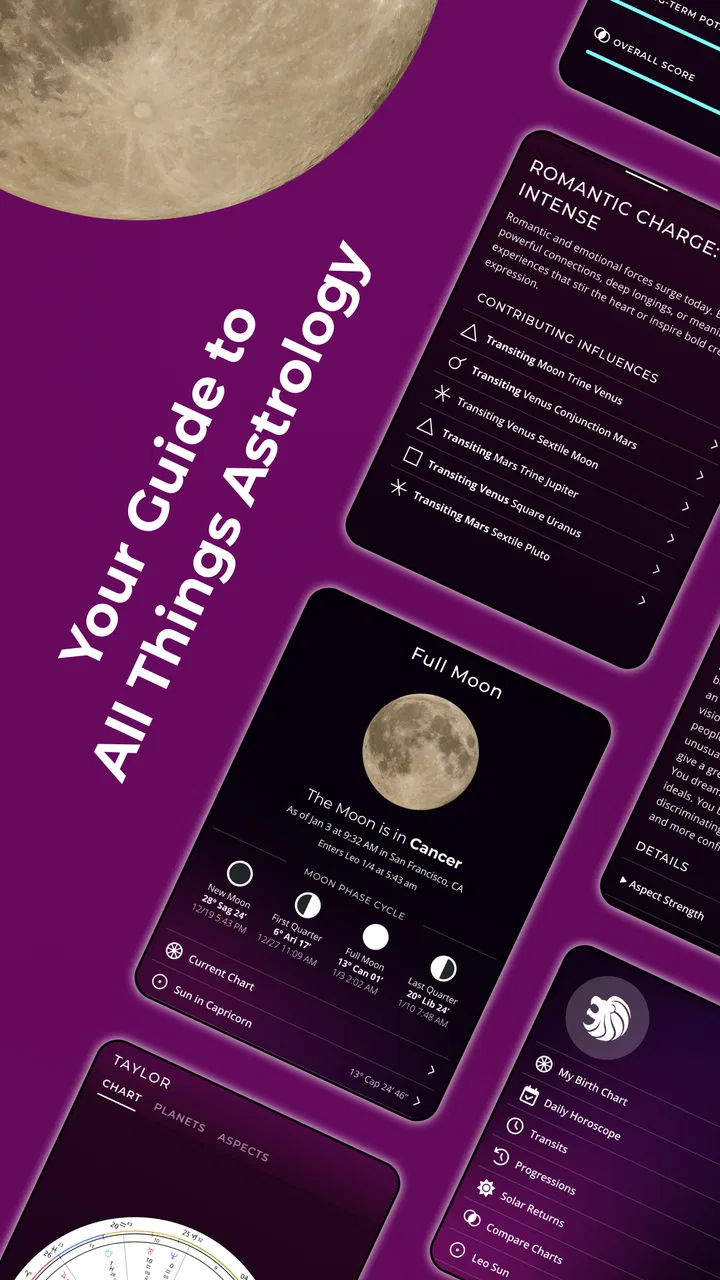
The first thing I noticed is that this is not simply a daily prediction feed. The app is built around astrology charts and the explanations attached to them, so there is more to explore than a short paragraph about the day ahead. That gives the experience depth, but it also means that a new user may need a little patience before the different symbols, terms and interpretations start to make sense.
I found it helpful to treat the chart as a starting point instead of trying to understand everything at once. Looking at one planet, sign or house and then reading its explanation is much less overwhelming than attempting to decode the entire chart in a single sitting. This is one of the app’s strongest qualities for learners: it gives you a reason to connect separate pieces of information rather than only presenting a finished conclusion.
The written interpretations are most useful when I read them alongside the chart instead of scrolling through them as isolated statements. That approach makes the app feel more like a reference tool. If you are completely new to astrology, you can use it to build familiarity gradually. If you already know the basics, you can move faster and focus on the parts of a chart that interest you.
Navigation is easier when I have a specific question in mind. For example, I might open the app to review my chart, then concentrate on relationships, personal habits or the general tone of the day. Without that focus, the number of possible directions can make the experience feel less direct than a conventional horoscope app. The trade-off is clear: a simpler alternative may be faster, while this one offers more context for people willing to explore.
Text-heavy astrology apps can be tiring for people who prefer visual summaries. The chart gives the experience a visual anchor, but understanding it still depends heavily on reading. I would recommend using the app in short sessions if long passages are difficult to process. Reading one interpretation, pausing, and returning later works better for me than trying to absorb a complete reading in one go.
Motor and sensory considerations
From a motor perspective, the most comfortable way to use the app is with deliberate, unhurried navigation. Astrology charts contain small visual details and several areas that invite exploration, so users with limited precision or hand movement may find some interactions less comfortable than a straightforward list-based app. A larger device can make the chart easier to inspect, whereas a compact phone may require more careful tapping and scrolling.
I also think about the app’s sensory demands. Astrology is presented through a mixture of symbols, visual chart elements and written interpretation. That combination is useful for people who like to connect images with words, but it may be less suitable for someone who finds dense visual layouts distracting. If you are sensitive to crowded screens, focusing on the explanatory text and ignoring the decorative or secondary elements can make the experience calmer.
For readers who process information better in small pieces, the app works best as a reflective tool rather than a rapid-fire feed. I would open it when I have enough attention to read and think, not while multitasking. The daily insights can fit into a routine, but I would not rely on them as background content while commuting, cooking or handling another demanding task.
People with visual limitations should judge the chart interface carefully on their own device. The written content may be more approachable than the chart itself, but astrology depends on both the visual arrangement and the interpretation. That makes the app potentially more demanding than a plain text horoscope, especially if distinguishing symbols or following a circular chart is difficult.
On the other hand, users who prefer written explanations over audio or video may appreciate the format. I can read at my own speed, revisit a passage and compare it with the chart instead of keeping up with a spoken presentation. That control is valuable for anyone who needs extra time to process unfamiliar terminology.
Using it in different situations
A realistic use case for me is a quiet morning check-in. I might look at the day’s astrological insight before planning a difficult conversation or deciding how much energy to reserve for a busy schedule. I do not treat the reading as a command. I use it as a prompt to reflect on what I already know about my mood, relationships and priorities. That makes the app more useful than a prediction I am expected to accept literally.
It can also work well as a personal journaling companion. I can read an insight, note what seems relevant, and return later to consider whether it matched my experience. This approach avoids the common trap of checking an astrology app repeatedly for reassurance. The value comes from reflection, not from asking the app to make every decision.
For someone who shares a phone or uses the app around other people, the content is easy to open privately, but astrology readings can still be personal. I would use it when I have a moment alone if I wanted to think carefully about relationships or emotional patterns. The app is rated for Everyone, yet the subject matter can still feel intimate depending on what you choose to explore.
Travel and changing routines are another reason to keep expectations realistic. Daily insights are convenient when you have a regular habit, but they are not a substitute for professional advice, mental-health support or practical planning. I would never use an astrological interpretation to replace medical, financial or safety-related guidance. It works best as a lifestyle and self-reflection app, which is also how its category makes the most sense.
The free entry point is useful for trying the basic experience before deciding whether it belongs in your routine. Optional purchases range from $0.99 to $99.99 per item, so I would pay attention before confirming anything. The wide range means the app can remain accessible to casual users while still offering paid choices, but anyone trying to keep spending tightly controlled should review each purchase carefully.
Where the experience becomes demanding
The largest barrier is the subject itself. Astrology charts use a vocabulary that can feel unfamiliar, and even clear explanations may not remove the need to learn basic concepts. A person who wants a single sentence each morning may find this app more involved than necessary. In that case, a simpler daily horoscope service would probably be a better fit.
Another limitation is the risk of overinterpretation. Detailed readings can feel persuasive, especially when they touch on personal concerns. I think the healthiest way to use the app is to compare its suggestions with real circumstances and keep your own judgment in charge. The app can encourage useful self-questioning, but it cannot know every detail of your life.
The visual chart may also create friction for users who expect a modern, highly simplified interface. Its purpose is to represent astrological relationships, not to reduce everything to a few colorful cards. That is a strength for serious learners and a weakness for people who want instant clarity. Before choosing it over a lighter alternative, ask yourself whether you enjoy investigating information or mainly want a quick daily message.
There is also a concentration cost. I can spend longer with a chart than I originally planned because each interpretation leads naturally to another. That is not a flaw for everyone, but it can make the app less convenient when I only have a minute. A useful personal rule is to decide what I want to examine before opening it and stop after that topic, rather than browsing without a limit.
Users who need highly predictable, low-effort navigation may prefer a more minimal app. TimePassages Astrology offers depth, but depth usually brings more reading, more terminology and more visual information. I would especially recommend testing it during a calm moment rather than judging it while distracted. The same richness that feels thoughtful at home can feel cumbersome in a noisy or rushed setting.
Who will get the most from it
I think it is a strong choice for people who want to understand their own birth chart instead of consuming generic predictions. It is also a good match for astrology learners who want to connect chart elements with written interpretations. The app gives those users something to return to, and its daily insights can provide a regular reason to keep learning.
It suits reflective routines particularly well. I can imagine using it with a journal, during a quiet evening or as part of a weekly review. The important distinction is that it rewards attention. If you enjoy asking why an interpretation might feel relevant and comparing it with your actual experience, the app has more to offer than a basic horoscope feed.
I would be more cautious about recommending it to someone who dislikes symbolic systems, wants scientifically validated forecasting or prefers decisions based only on measurable information. The app is not the right tool for those expectations. It is also not ideal for anyone who wants zero-cost use with no temptation to make optional purchases, despite being free to download and begin using.
Compared with a typical horoscope alternative, this app feels more personal and more educational, but less immediate. A lightweight horoscope app may win when you want a quick glance and nothing else. TimePassages Astrology wins when you want to inspect the background behind an interpretation and build a clearer picture of how astrology is structured.
My inclusive verdict
After using it as both a daily lifestyle tool and a chart reference, I see TimePassages Astrology as a thoughtful option for readers who are comfortable with a text-rich, detail-oriented experience. The app supports different contexts reasonably well because you can approach it briefly or spend time studying a chart, but its accessibility depends on your comfort with small visual details, reading and unfamiliar terminology.
AstroGraph Software has made an app that feels more substantial than a stream of interchangeable predictions. It has been available since February 14, 2020, and the current version is 3.1.5, while support begins with operating system version 9. It has passed half a million installs, which fits the impression of an established astrology tool rather than a novelty made only for occasional curiosity.
My advice is to start slowly: read one chart element, use one daily insight as a reflection prompt, and decide whether the style helps you think more clearly. Do not judge it solely by the first screen, and do not feel obliged to accept every interpretation. The best way to use this app is as a personal reflection aid, not as an authority over your choices.
Overall, I would recommend it to anyone who wants a deeper astrology experience and is willing to read, explore and form their own conclusions. I would steer casual users toward a simpler alternative if all they want is a fast horoscope. For the right audience, though, the balance of chart detail and daily guidance makes it a worthwhile free lifestyle app to try, with optional purchases worth approaching thoughtfully.
FAQs for TimePassages Astrology
01What is TimePassages Astrology, and what can I use it for?
TimePassages Astrology is an astrology app designed to help you explore natal charts, planetary positions, transits, aspects, and other horoscope information. After entering your birth date, exact time, and location, the app presents an interpretation of your chart and current planetary influences. It is useful for beginners who want guided explanations, as well as experienced astrology users who prefer a convenient mobile chart reference.
02How accurate does my birth information need to be?
The accuracy of your results depends heavily on the information you provide. Your birth date and location are important, but the exact birth time is especially significant because it affects your rising sign, house placements, and the timing of certain interpretations. If you do not know your birth time, you can still explore parts of the chart, although some features and readings may be less precise or should be treated as general guidance.
03Is TimePassages Astrology free to download and use?
TimePassages Astrology can generally be downloaded at no initial cost, but access to all of its content may depend on the version available in your region and the app’s current purchase options. Basic chart features may be available for free, while detailed interpretations, extra reports, additional charts, or advanced tools can require in-app purchases or a subscription. It is worth checking the store listing before downloading.
04Does the app provide daily horoscopes and personalized transit information?
Yes, TimePassages Astrology focuses on more than generic zodiac horoscopes. It can help you review planetary transits in relation to your personal birth chart, making the information more individualized. Depending on the feature and account level, you may also find daily or periodic horoscope content. The app is best suited to users who want to understand why particular astrological themes are being emphasized rather than simply reading a short sun-sign prediction.
05Is TimePassages Astrology suitable for beginners, and should I treat its readings as factual advice?
The app is relatively approachable for beginners because it explains many astrological terms and organizes chart information in a readable way. However, users unfamiliar with astrology may still need time to understand houses, aspects, retrogrades, and transit interpretations. Its readings should be viewed as entertainment, reflection, or a symbolic self-exploration tool—not as scientific fact or professional medical, financial, legal, or relationship advice.
Pros
- Detailed natal charts with many planets
- houses
- and aspects
- Accurate ephemeris data supports serious astrology research
- Daily transits help connect current planetary movements to your chart
- Includes educational explanations for users learning astrology
- Clean interface makes complex chart information easier to navigate
Cons
- Many advanced features require separate purchases or a subscription
- The amount of chart data can feel overwhelming for beginners
- Some interpretations may be too technical without astrology knowledge
- Notifications and transit updates can become excessive for some users
- Chart calculations depend on entering precise birth details and location

TimePassages Astrology
Gallery